



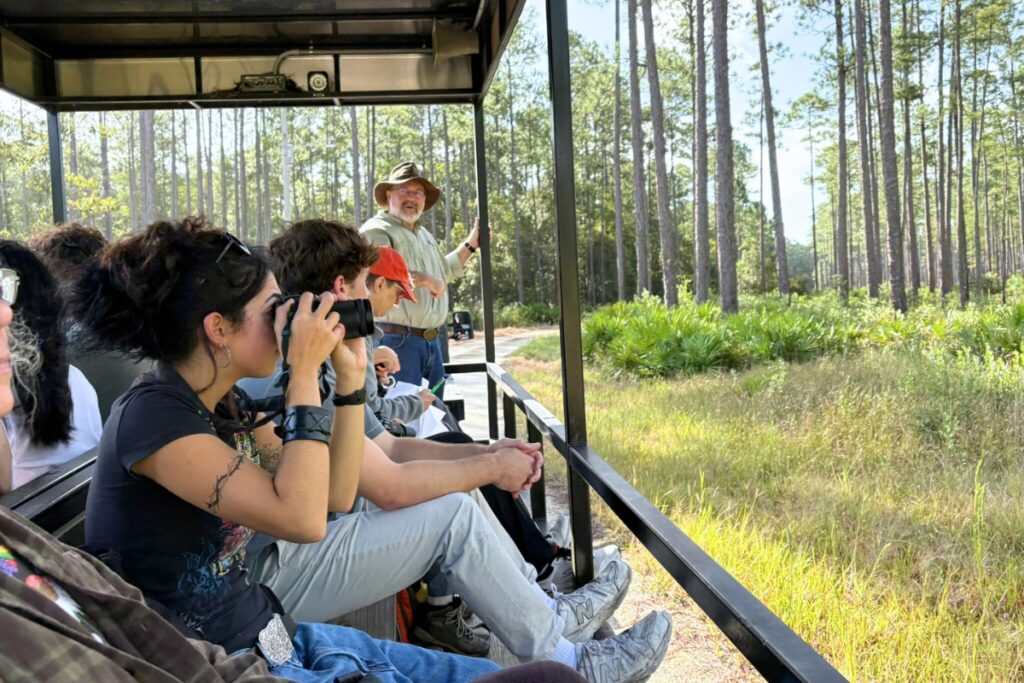
A group of University of Florida art students doesn’t need to be told to go out and touch grass, as getting out into nature is part of the assignment.
During the past semester, and for the 15th year, faculty and staff with the School of Forest, Fisheries, and Geomatics Sciences welcomed UF Art Professor Katerie Gladdys’ students in her Video Art class to the Austin Cary Forest so students could develop 2-3 minute videos that interpret the idea of a dialog or an interview in an expressive and poetic manner, using the forest as setting and inspiration.
“Students’ initial reaction is amazement that UF has a teaching/research forest … (and) are impressed with the scale and size of the forest,” Gladdys said. “Many are also really interested to learn about the role of fire for the maintenance and health of a Southern pine forest.
“Slash pine forest stands are ubiquitous in the North Florida landscape and students are surprised about the richness and diversity of the ecosystems, the amount of plant and animal life that Austin Cary sustains.”
The terms “dialog” and “interview,” in this assignment, were flexible and allowed students to figure out their own way to incorporate the forest into their work.
“While I was in the forest, I tried to capture the movement of the grasses in the wind, their movement as a result of pollinators, and their movement as a result of my touch for the purpose of comparing these interactions,” said Helen Augustyn, who is majoring in art. “With green screen elements, I then added the presence of another entity that is almost like a narrator/director capturing these movements on paper as a way of documenting them and interacting with the video in a secondary way.
“The music was something I improvised on the cello as a way of adding human-made sound to that of the natural environment. The communication in this video is therefore not so literal but is rather an abstracted conversation through other forms of interaction.”
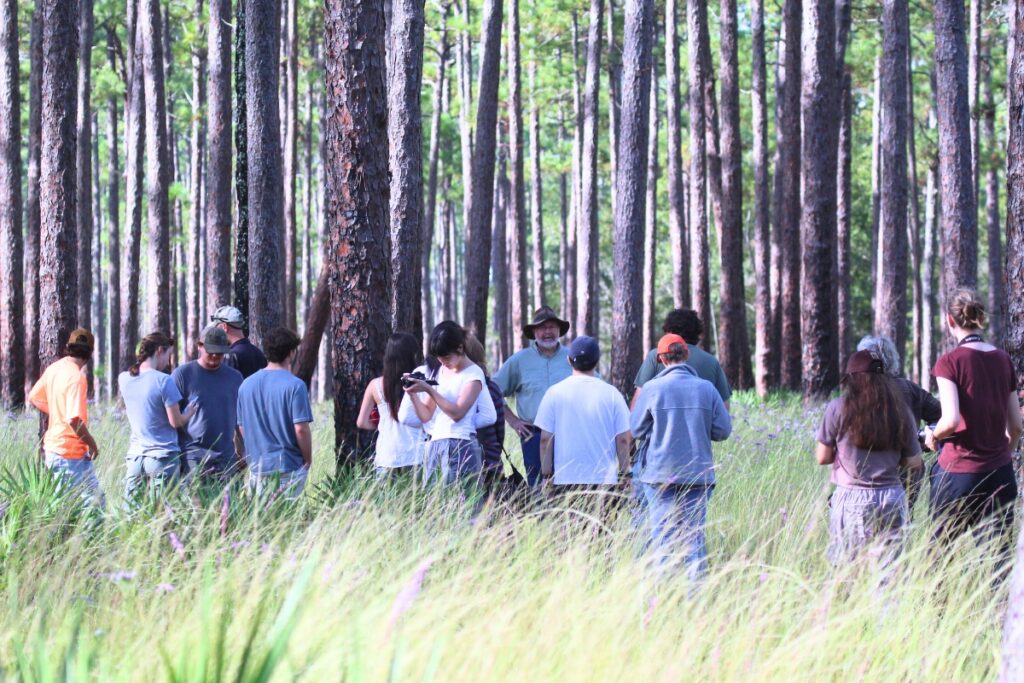
While students could have taken only one or two trips to the Austin Cary Forest for their projects, most went several times.
“Students expressed that they kept seeing new aspects every time they went out and wanted to film more,” Gladdys said. “For instance, on the first trip there are numerous test shots that include the Liatris flowers in the burned grassy plot near the Learning Center, but then students will start to notice the insect and follow the insects through the vegetation and then become interested in learning more about the relationship between the insects and the understory.”
The Fall 2025 group of Video Art (ART 3959C) students included a significant number of seniors, along with Florida Foundation Research Professor, Dr. Corene Matyas, a climatology professor in the Department of Geography who specializes in precipitation and extreme events.
“I returned to art as another mechanism to communicate science,” Matyas said. “My goal is to incorporate scientific information into my artworks, and water and trees are a major theme in my work.
“When our class toured the forest, we learned there was a tree recently hit by lightning and you could see the scars from the road. I decided to conduct my unconventional interview with the tree and surrounding plants that would have witnessed the strike. The original concept was to conduct interviews as social scientists do after disasters, which was timely considering it was the 20th anniversary of Hurricane Katrina this August.”
Matyas interviewed Scott Sager, SFFGS assistant director, regarding lightning strikes in the forest, then incorporated weather radar data from the strike into their video.
“But along with the technical science, I also wanted to show a personal and sensitive connection with the forest,” Matyas said. “I developed a series of taps and scratches that I would use to communicate with the plants and I fashioned a listening device out of a ceramic funnel that I made and a lapel microphone to record responses.”
The assignment’s proven to be a memorable one over the years.
“Often when I bump into and speak with alumni,” Gladdys said, “they remember the time they spent at Austin Cary with a great deal of fondness and excitement about experiential learning.”

Suggested Articles
No related articles found.