





- Satchel Raye rejected a $6,000 ADA lawsuit settlement against Satchel's Pizza and the case was dismissed with prejudice, ending the legal battle.
- Plaintiff Makeda Evans filed 52 ADA lawsuits mostly targeting local businesses for website accessibility issues over the past 18 months.
- The lawsuit involved website accessibility for the visually impaired, and Raye plans to educate others about ADA lawsuits and pursue legal reforms.
Satchel Raye said he’d only pay to settle the lawsuit against Satchel’s Pizza if a judge demanded it. He’d been offered a $6,000 settlement—an easy exit ramp for a business with $3.5 million in annual sales.
His lawyer double checked to make sure he wanted to pass on the deal.
Raye told Mainstreet that he can have scruples because he has the backing, even if he wouldn’t advise another business owner to take the same path. The total cost if he lost in court could easily stretch tens of thousands of dollars.
“I wouldn’t give her $6 right now. I don’t want to give her anything. If I can get away with not giving anything, then to me, I’ve won,” Raye told Mainstreet on Monday.
Less than 48 hours later, on Wednesday afternoon, Raye got an email while waiting for lunch: the lawsuit was dropped by plaintiff Makeda Evans.
“Obviously, it’s just a huge relief,” Raye said.
The lawsuit centered on the Americans with Disabilities Act (ADA) requirements for business websites to be accessible to blind and visually impaired users. Evans has filed 52 of these ADA lawsuits over the last year and a half, primarily against local businesses like Spurrier’s Gridiron Grille, Gainesville Health and Fitness, Harry’s Seafood Bar and Grille, Northwest Seafood and Uppercrust Bakery.
Mainstreet revealed the breadth of the lawsuits in December 2025 and how Gainesville business owners reacted to the onslaught of lawsuits. The article caused other business owners to double check compliance, spurred readers to support impacted restaurants and resulted in additional coverage by media outlets. It quickly became Mainstreet’s most viewed story of 2025.
After the story, no local businesses were sued for ADA website compliance in January—the first time in 16 months. In February, Evans filed two lawsuits against businesses in Colorado, a hotel and a restaurant.
Of the 52 local businesses, the vast majority have paid settlements. There are still eight active North Central Florida cases, but settlement agreements are already working through the court system for five of those businesses.
Gainesville lawyer Gary Edinger, who represents Raye and other sued businesses, told Mainstreet that owners face huge pressure to settle. He called Raye the ‘toughest kid on the block’ for sticking with the case.
The other three cases—The TOP, Gainesville Health and Fitness and bb.q Chicken—remain active without settlement agreements showing up in court records.
Raye said fighting the lawsuit has consumed his hours since November. He’s been typing Facebook posts to keep customers updated and responding to long email threads with community residents, business owners and his own attorney.
The emails include a business owner in Jacksonville also facing an ADA lawsuit as the litigation continues to crop up across Florida. He also talked with two people who filed Florida Bar complaints against Evan’s attorney, Aleksandra Kravets. Kravets had filed over 200 cases when Mainstreet spoke with her.
Raye said his 65 employees keep busy with their jobs and don’t discuss the lawsuit. But he still keeps busy chatting about it.
“The employees are going about their business,” Raye said. “It’s more the customers; it’s all they want to talk about. They’re like ‘oh, you’re fighting it. That’s great.’ I’m like, ‘It’s not that great.’”
In December, Raye filed motions against Evans’ claim that his restaurant’s website violated ADA compliance. His IT expert said the website could easily be navigated by anyone familiar with the text-to-speech software used by the visually impaired.
Many of the issues, Raye said, dealt with third-party businesses. He said Satchel’s Pizza linked to 352 Delivery to provide pizza delivery. Raye refuses to deal with national cooperations like DoorDash and Uber Eats. He’s just not interested.
“We’ve never used any of these big names because I want to use a local company,” Raye said. “This guy, Jeremiah, owns 352 Delivery. He pays his people wages, and they’re not just contract workers. I like the way he runs his business.”
But Raye said Evans also found ADA faults with the 352 Delivery website linked to his restaurant’s web page. So he removed the link to end the problem. Now in its place, there’s just a message to go straight to 352’s website.
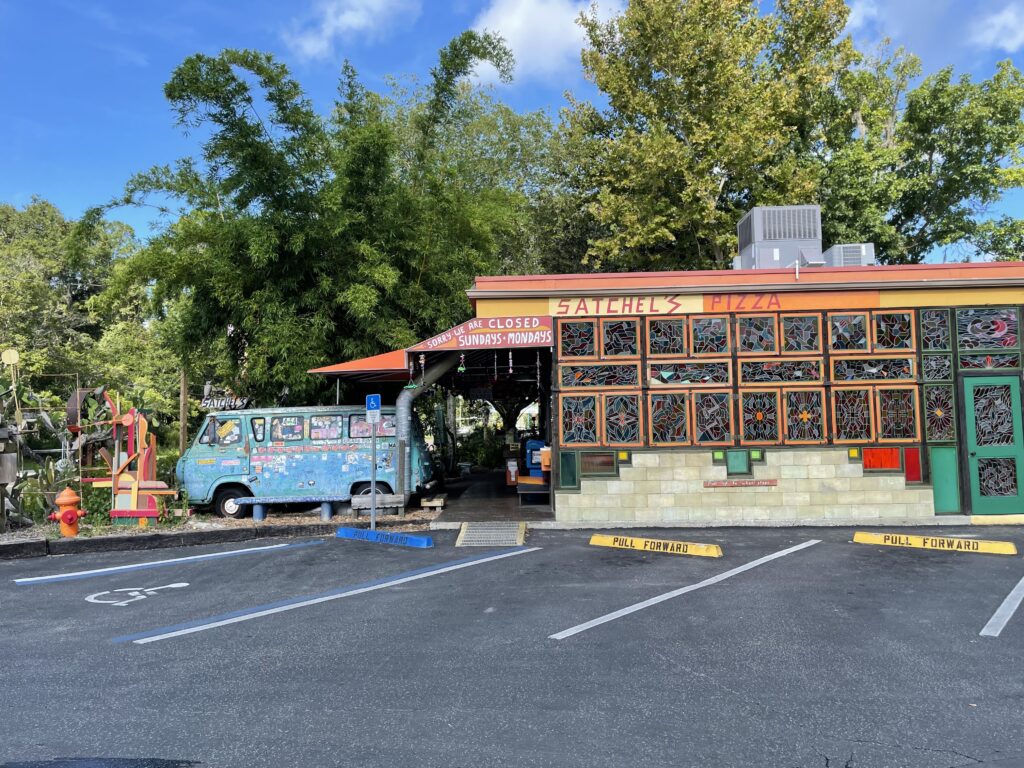
Raye said that because Satchel’s Pizza is no longer directly linked to the delivery company’s website, customers will probably scroll past three other pizza places before they reach his, but it’s a price he’s willing to pay, especially since delivery is a small portion of the business anyway. Most customers want to visit in person and see the restaurant’s stained-glass walls made by Raye, pennies glued to tabletops and his 1965 Ford Falcon van fit with dining tables.
Raye said Edinger tipped the legal billing in his favor because he supported the cause after litigating so many ADA cases.
Hiring an attorney for the last three months of legal work would cost around $12,000 to $15,000. If the lawsuit had stretched until a scheduled nonjury trial in October, the costs would be even higher. Plus, if Raye lost the trial, he’d need to cover the opposing attorney fees.
Raye’s case was dismissed with prejudice, meaning Evans can’t sue him again, but another plaintiff could. He said he thinks complaints to the Florida Bar against Kravets, specifically mentioning his restaurant, applied pressure leading to the dismissal.
While the legal battle might be over for now, Raye said he wants to help educate as many people as he can about the ADA lawsuits. He’s already got two podcast interviews scheduled and intends to meet with U.S. Congresswoman Kat Cammack again to pursue changing the laws.
“This isn’t just about me. It’s about all these other businesses, you know?” he said. “If I just dropped everything, it would kind of defeat the purpose of fighting it.”
So, should he have taken the $6,000 settlement? Raye said no. Was the fight worth it? Raye also said no, but somebody has to do it.
“There’s no winning. There’s winning in a way. I mean, it feels like a win for sure—absolutely,” Raye said.
Suggested Articles
No related articles found.
I think it’s important to say that making my website compliant for the visually impaired was my main goal from when this started. I thought “If I can make my website compliant then it will be available to the visually impaired, maybe the lawsuit can go away, and hopefully I won’t be sued again.” This isn’t an easy task especially because a blind person can claim something is confusing that might also be confusing to a sighted person. The government has yet to define a specific standard and websites and standards often change. It’s a daunting task. But throughout the process, and with the help of many helpful customers, we were able to keep making the site more compliant trying to achieve that AAA grade. Sometimes going from A to AAA means tweaking contrasts on screens most people will never see. Winning this lawsuit feels like a reward for the work I and others have done. Community members came together to give advice and help seek bigger solutions. Small businesses have to struggle with so many things that getting sued shouldn’t be one of them. There are better ways to make the world visible to the blind. It starts with respecting our community and speaking up when we see things that are wrong. I’m all for ADA compliant websites and next the challenge is to find ways to achieve that without extorting small businesses. I appreciate our customers and our community for all the support I’ve felt over this. Thank you.
Did Cammack reach out to you or did you have to initiate discussion? I would like to think her staff would have been all over this as soon as the story broke. Clearly, some work needs to be done on the legislation, the regulations that flow from that and the local enforcement process.
Well done, Satchel! The laws should have never been enacted without including the provision to give first a warning and an opportunity to fix problems. Also the issue is the “readers” are old technology that has not advanced in years. Instead of forcing thousands to make changes, the readers need to be improved. In the end it seems tort and unscrupulous lawyers are the only ones winning.
Thank you Satchel for being strong and communicating to us all what has been going on. I am not fully updated on the case, but my first instinct was to ask why was there no warning or time allowed to become compliant? I hope these businesses sue this lawyer for using her practice for nefarious purposes and I also wonder if there is some other common denominator (besides money) that she was specifically targeting. There are people in this country that hate certain groups of Americans and sit around all day thinking of ways to sue them into oblivion.
Those of us who have been involved would be happy to share documents with other local businesses about the bar complaint that was filed and our response to the defense. We filed documents and one week later the suit was dropped – maybe the documents tipped the scale to drop the suit. Provide your contact info to Mainstreet and we will follow up.
I filed a bar complaint against Evan’s’ lawyer in December and posted on Facebook the link and the lawyers bar number encouraging others to follow suit. I’m so glad to hear that the case was dropped and I commend you for standing your ground. This news really made my day!
I filed a bar complaint against Evan’s’ lawyer in December and posted on Facebook the link and the lawyers bar number encouraging others to follow suit. I’m so glad to hear that the case was dropped and I commend you for standing your ground. This news really made my day
There is already a bill pending that will stop the law suits. https://www.congress.gov/bill/119th-congress/house-bill/6453/text
OMG YES!!!! Maybe our letter blasts to the state and feds actually made a difference!
So I guess Evans has moved to Colorado now? or since it is website ADA compliance, she can be anywhere? I see the involved Attorney also has a Plaintiff helping her do the same in Jacksonville now.
Satchel and his restaurants are a piece of what makes Gainesville such a great place to live. So many of us have had family celebrations and joyful time together while enjoying the best pizza in Florida at Satchel’s. Thank you, Satchel, for being you.
Congratulations Satch!
I’m supportive of Satchel’s approach and sticking to his values. Yet I wonder if Evans was asked to comment? Why did he/she do this? What does he/she have to say? Would’ve made for more balanced reporting, don’t you think?
Satchel tried to talk with her. She was given the opportunity to talk with Satchel but declined. She left the talking to her attorney.
Glad to hear the case was dropped!!! It’s disturbing that all these cases were being filed by one person and one lawyer; seems nefarious. Warnings to be compliant should definitely have been issued long before cases filed. Your tenacity is commendable. I wish continued success for Satchel’s and like-minded small businesses.
Congratulations to Satchel for fighting and winning on behalf of small businesses in Gainesville.
Obviously making websites more accessible should always be the goal because it’s better for everyone and it represents sound web development principles. But these lawsuits were not intended to make things better. They were intended to line the pockets of lawyers.
For those interested I wrote a quick blog post about web accessibility and some quick fixes you can make right now to improve your website.
https://www.brucefloyd.com/ada-website-accessibility-a-simple-checklist-for-gainesville-florida-small-businesses/
Good work. I found out about this from a local business owner, that did not get sued, but wanted to avoid it, and has redesigned their site. It’s not easy as you said. The amount of things that wear us down, as a past Gainesville small business owner, I know they are endless, but stuff like this, when there is no opportunity to just get it right, clearly is for monetary gain. Thanks for taking the time and energy not only to fight, but to communicate.