



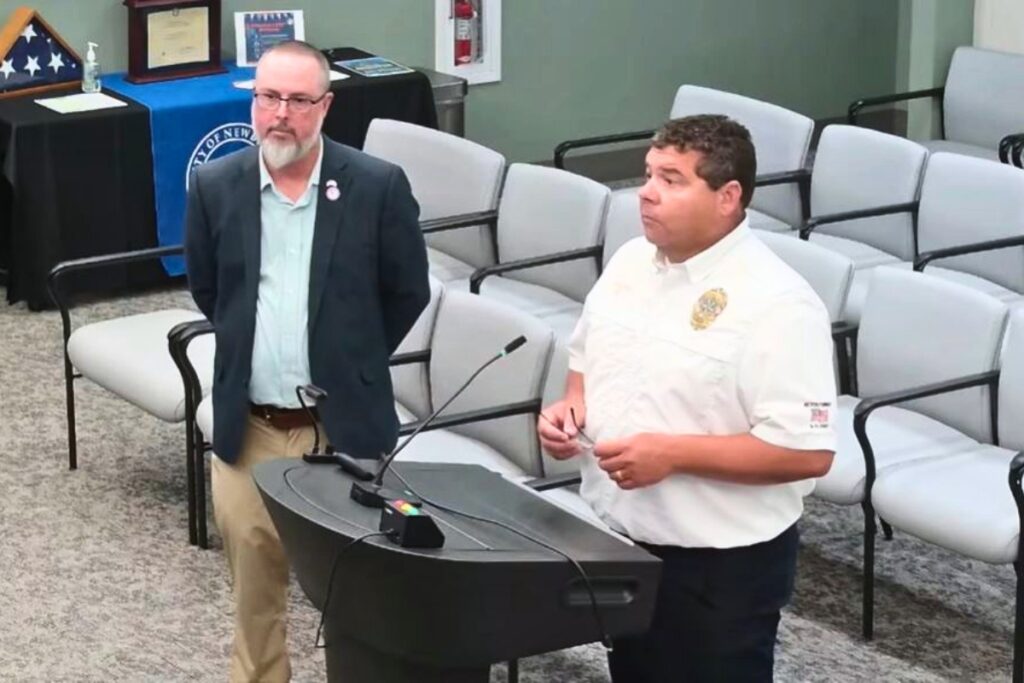
- Newberry City Commission approved a $600,000 purchase of 9 acres for Environmental Park expansion and a regional fire training facility.
- State appropriations of $750,000 funded the burn box training facility, with construction starting in fiscal year 2026-27.
- The property includes a home to house wastewater plant managers and could convert to a future fire station saving millions.
The Newberry City Commission unanimously approved a $600,000 purchase of nine acres as an addition to its Environmental Park with multiple intended uses, including a regional fire training facility.
During a regular meeting on Monday, City Manager Jordan Marlowe called the 8.83-acre acquisition located west of Champions Park an exciting opportunity that would help Newberry in the three-year buildout of its new $80 million wastewater treatment plant and down the road as it plans to increase fire safety coverage with growth.
The city began looking for land after receiving $750,000 in state appropriations to build a regional fire training facility known as a “burn box” — $500,000 last year and $250,000 this year. Marlowe said the city risked losing the funding if it did not identify a property for the facility.
Marlowe said the department spends about $150,000 a year to send firefighters to ISO-mandated training at the closest training facility in Lofton, leaving fewer firefighters available for calls during those sessions.
Newberry Fire Department Chief Jason Lyman said the upfront costs of the land and burn box would be offset by long-term savings by allowing the city to train local firefighters while they are on shift and generate revenue through other opportunities.
Lyman said the facility could partner with local schools to offer vocational programs, host firefighter competitions and would not burn toxic or hazardous materials that could harm nearby residents.
Marlowe said Levy, Gilchrist and Dixie County have already expressed interest in using Newberry’s burn box, and Alachua County might too, since their $350,000 appropriation request for a new training facility was denied.
Construction on Newberry’s burn box will start in the 2026-27 fiscal year.
“The possibilities are limitless if we put in the structure that will accommodate all of that,” Lyman said. “And the structures that we’re looking at are also easily expandable. They’re kind of like a large Erector Set, so that if we choose a different direction in the future, we can make modifications.”
Out of the properties staff considered, Marlowe said these nine acres were particularly valuable because of their location and multi-purpose nature. Two appraisals valued the property at $548,500 before the negotiated purchase price.
Marlowe said owning these nine acres positioned the city for an additional six nearby, which he said could position a future commission for another Environmental Park expansion.
The acreage also includes a home that the city plans to use to house construction managers for the wastewater plant.
The engineering company will pay the city $50,000 to house the project manager, plus another $50,000 in pro-bono work, bringing the city’s property purchase expense down to $500,000.
Marlowe said the extra funds will help because the state appropriations can only go toward the construction of the burn box, not the land purchase. The city will need to borrow to cover the roughly $250,000 gap between the appropriations and the estimated $1 million construction cost.
Assistant City Manager Dallas Lee said $95,000 of impact fees could also be used for constructing the new roadway that will connect the Environmental Park to SW 30th Avenue for firetrucks going in and out.
Once the wastewater project is finished, Marlowe said the home can be rented out or used with a new fire station. He said the city should plan for another station with incoming developments like Sandia Park, even if the station doesn’t come for a while.
“Having a fire station in the Southwest quadrant of Newberry would be a benefit. That may be 20 years from now, but we would have a place for that,” Marlowe said. “The house could easily be converted, according to the chief, to the living quarters of the fire station, saving us millions of dollars down the road.”
Suggested Articles
No related articles found.