



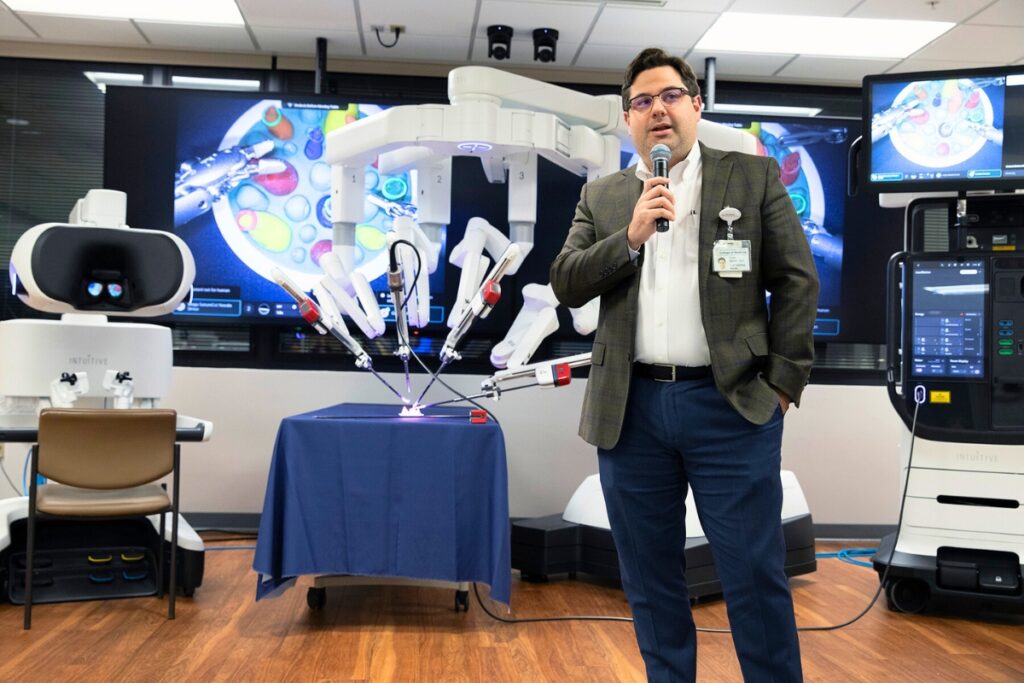
- HCA Florida North Florida Hospital introduced a new da Vinci 5 surgical robot for abdominal and pelvic operations in November.
- The da Vinci 5 provides advanced camera and tactile feedback, helping surgeons perform less invasive surgeries with faster patient recovery.
- Dr. Peter Sarantos has performed about 2,200 robotic surgeries since 2015 and shifted from laparoscopy after witnessing robotic surgery benefits.
After a pair of jumbo novelty scissors snipped a ribbon held by human hands, the action was repeated in miniature: tiny surgical scissors cut through a ribbon suspended between robotic arms.
Applause and cheers erupted from onlookers, a small crowd gathered Tuesday night at HCA Florida North Florida Hospital to meet the newest member of the Gainesville medical facility’s growing robotic surgical fleet, an advanced soft tissue surgical robot for abdominal and pelvic operations.
Earlier in the evening, many of the audience members had controlled the robot’s arms themselves. They took turns peering into a stereo viewer to see their own hand movements translated to tiny forceps that placed rubber bands among the peaks and valleys of a colorful model used for training.
“This robot, it actually helps me to see patients recover faster, better, with less issues,” said Dr. Francisco Macedo, chief of surgical oncology at HCA Florida North Florida Hospital. “And that gives me great, great satisfaction. I think we’re leaving that era of big surgeries mean big scars.”

Since HCA Florida North Florida Hospital acquired the new surgical robot, a da Vinci 5, in November, Macedo and his colleagues have used it to perform about 30 surgeries.
Like the five other surgical robots the hospital uses for abdominal and pelvic operations, the da Vinci 5 is manufactured by Intuitive, a California-based biotechnology company. The machine consists of three main components: a console where the surgeon sits and remotely controls the surgical instruments, a patient cart where the surgical instruments are located and a tower that houses computer processors, a monitor display and instruments like an endoscope.
While operations conducted with any of the hospital’s surgical robots generally lead to smaller incisions, less blood loss, less pain and shorter patient recovery times than those associated with more traditional surgery methods, the da Vinci 5 has an advanced camera system and tactical feedback so doctors can better “feel” tissue as the surgical instruments manipulate it.
“This is the newest, latest and greatest, bringing really quite innovative and cutting-edge technology to the field,” said Mark Amox, HCA Florida North Florida chief operating officer.
HCA Florida North Florida Hospital surgeon Dr. Peter Sarantos has performed an estimated 2,200 robotic surgeries since 2015. Trained during the era of laparoscopic surgery, he was initially reluctant to rely on robots in the operating room.
Sarantos said his mind changed after he received permission to observe his brother-in-law’s abdominal surgery.
“I watched the surgeon do a surgery that I could not have done laparoscopically, that I would have had to do (as open surgery),” Sarantos said. “If I had operated on my brother-in-law, he would have had a big zipper.”


Suggested Articles
No related articles found.
Hope everything is clean.