



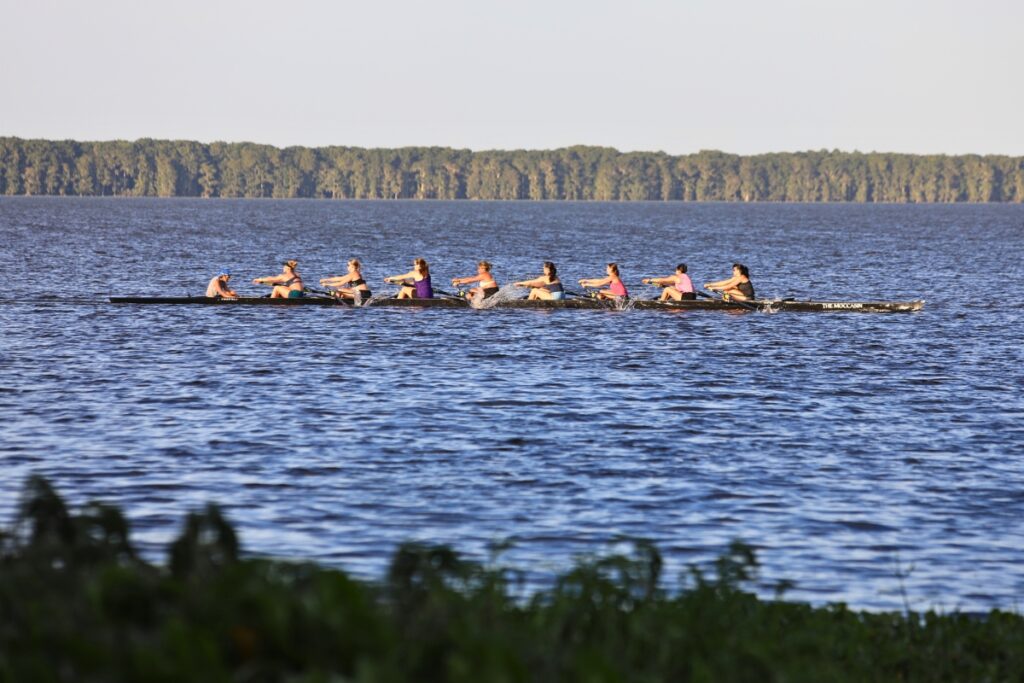
- Gainesville Area Rowing (GAR) will relocate from Newnans Lake to Lake Santa Fe due to water levels being about five feet below normal from drought since 2025.
- The move aims to allow GAR to finish the season's competitions but poses challenges like no boathouse and longer commutes potentially lowering membership.
- Newnans Lake's drought has also impacted firefighting efforts, with helicopters drawing water from it during recent wildfires in Alachua County under state of emergency conditions.
With six weeks left in the season, Gainesville Area Rowing (GAR) coach Garrett Bauer made a decision on Tuesday that hasn’t been considered for his team in almost 20 years: the club will relocate from its Newnans Lake headquarters to Lake Santa Fe in Melrose due to low water levels at Newnans.
Bauer said the move will help his team get through the remainder of the competitive season, including this weekend’s Sweep state regatta championships in Sarasota, regionals and nationals. But the move will also present challenges that likely won’t resolve until Newnans Lake water levels return to normal, which could take years.
“Pretty much since the middle of last summer 2025, the water level has kind of been steadily going downhill, and it hasn’t really recovered at all, haven’t had much rain,” Bauer told Mainstreet. “Now, we’re about five feet below the normal level.”
GAR has been rowing on Newnans Lake since it started 28 years ago. The nonprofit offers middle school, high school and master’s programs and has grown to state and national caliber after winning its first two state championships last year.

This year’s high school program has already celebrated three NCAA Division I scholarship commitments, including one from an Ivy League school, with around three more expected in the coming weeks to total the highest number of rowers participating in college that GAR has ever seen.
But the ongoing drought could stifle that success.
This week, Alachua County issued evacuations and declared a state of emergency for multiple active wildfires sparked during the drought. Firefighting helicopters pulled water from Newnans Lake during rowing practice to help battle the flames.
The Suwannee River Water Management District’s rain deficit since last spring has grown to 19.98 inches and the Floridan aquifer’s overall upper level dipped below the 20th percentile for the first time since 2011 last month. Alachua County remains in a modified Phase III Severe Water Shortage.
According to the Florida Fish and Wildlife Conservation Commission, Newnans Lake water levels are extremely low. The Owen-Illinois Park ramp closed in October for motorized vessels and only small boats and paddlecraft can launch from the Earl Powers Park ramp.
Bauer said GAR moved lakes because of a drought in 2009 and it took two years before they could return to Newnans Lake.
Since he started rowing with the program as a middle schooler in 2012, he said he’s never seen the 5,800-acre lake this low and that his team is fortunate to have made it this long without moving yet. He said it’s because GAR’s dock used to be an old fish camp that got dredged in the 1980s and 90s, which made the area deeper than everywhere else.
GAR’s neighbor, the University of Florida’s (UF) Club Rowing, will also need to relocate from Newnans, Bauer said. The club has been walking boats to GAR’s dock a few hundred yards away because theirs has been too dry for the past several months. Bauer said UF is looking to move to Lake Alto for practice.
Although he’d been thinking about moving for a while, an accident last week spurred Bauer to act now.
While out on a single row, longtime GAR masters rower Jen Figueroa totaled her boat after hitting a tree stump that would’ve normally been submerged under water. Figueroa walked the boat back through water that’s been increasing in dead fish and alligators as the waters shrink.
“The rower is OK, the boat is not,” Bauer said. “After that, I’m like, OK, we kind of need to move up our timeline.”
Bauer said moving will have its challenges both immediately and long-term.
GAR will initially set its boats up in the backyard of a Lake Santa Fe resident. Bauer said he’s hoping to move his team to a community park on the lake as a longer-term solution, but needs permission from all 14 residents who own a piece of the park to do so.
Regardless of where GAR moves, not having a boathouse like at Newnans Lake will leave equipment exposed to sun damage.
Bauer is also expecting a drop in membership and recruitment because of the extra 15- to 20-mile commute.
GAR parent and board member Caroline Parker said driving to Melrose is a time and financial burden on families with the high gas prices. Although GAR is considering finding a bus to take rowers to practice, it would be another financial commitment it doesn’t know it can make.
Unless someone has a private lake to offer, Parker said Lake Santa Fe is the closest viable source of water.
“[Our daughter is] a junior, she has colleges talking to her for opportunities for scholarships, academically and through rowing, and so it’s not like we can just throw in the towel and just stop rowing. It’s such a big opportunity and she loves it,” Parker said.
Unless he can get everyone to do a rain dance, Bauer said GAR will have to rely on donations from individuals and businesses in the community to stay afloat through the drought.
“It’s kind of bad all around, but at least we’ll be able to row and continue our season and make sure these kids can fulfill their dreams,” Bauer said. “They’ve been working so hard for the last couple of years.”
Suggested Articles
No related articles found.