



- Alachua County Public Schools launched the 'Our Schools – Future Ready' plan in November 2025 to address enrollment, capacity, and programs.
- Three draft boundary scenarios propose closing Foster and Rawlings elementary schools and shifting boundaries for all levels.
- Oak View Middle School will convert to pre-K through eighth grade in fall, absorbing Newberry Elementary students due to its charter conversion.
- Community input shaped these scenarios and ongoing feedback will refine them through interactive maps and sessions until Feb. 18.
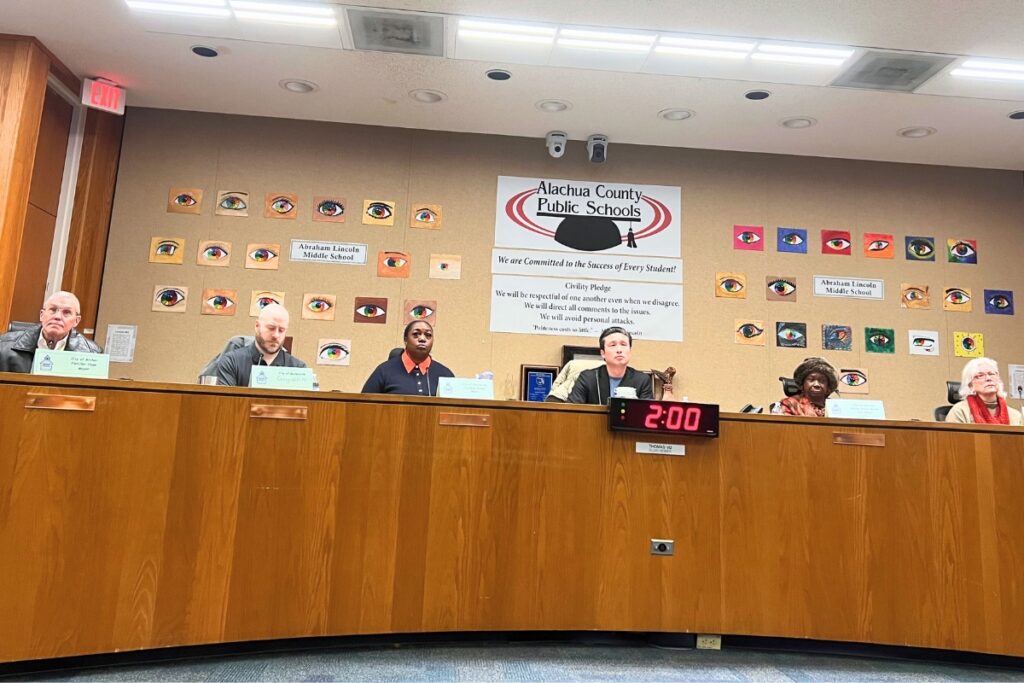
Elected officials across Alachua County gathered in the Alachua County Public Schools’ (ACPS) District Office boardroom Friday morning to hear and provide input on the district’s ongoing comprehensive school strategy plan labeled “Our Schools – Future Ready.”
The meeting lasted nearly two hours and included participation from city officials in Archer, Alachua, Gainesville and Hawthorne, along with county and school board officials.
ACPS has been collaborating with Gainesville-based engineering and planning firm JBrown Professional Group, or JBPro, to implement a three-phase school strategy plan. This plan, launched in November 2025, addresses key issues such as enrollment and school capacity, transportation and educational programs.
A November 2025 ACPS release said the plan would “outline both short-term strategies for the start of the 2026-27 school year and a long-term roadmap to support strong schools across the district.”
Phase one was held in November and December, focusing on listening to community members across Alachua County. This was done in large part through eight community input sessions that took place on school campuses throughout the county.
“We actually had 2,300 individual people participate in 50,000 individual responses through our engagement efforts in terms of visioning what the future of our district should look like,” Kathie Ebaugh, a planning director for JBPro, who is also serving as the project manager for ACPS’s Future Ready initiative, said during a presentation on Friday. “We took of all that information, and we added it to some data…to come up with draft (school boundary) scenarios.”
ACPS released nine draft school boundary maps on Monday – three each for elementary, middle and high schools.
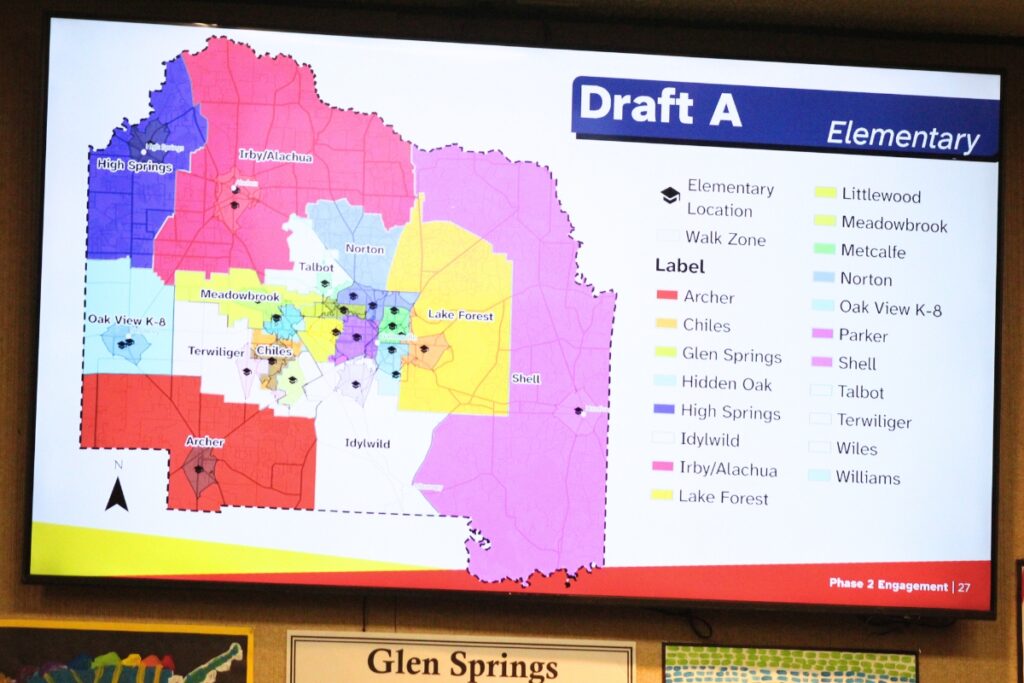
Ebaugh went through the three alternative boundary scenarios – A, B and C – for elementary, middle and high schools, noting these scenarios were based on feedback from community members and their vision, which includes a focus on students.
“In student focus, we’re making sure that as we look at these boundary scenarios, we’re focused on the student,” she said. “We’re focusing on their opportunities; we’re ensuring the programs are maintained and that every student has their needs met – no matter where they go to school.”
In all three elementary draft scenarios, boundary lines are shifted. Foster Elementary School would close, and the magnet programs at the school would move to Norton Elementary School.
Additionally, Oak View Middle School, which currently serves grades 5-8, would convert to pre-K through eighth beginning in the fall.
In an email reply to Mainstreet on Thursday, Jackie Johnson, a spokesperson for ACPS, said Oak View would take in most of the students from Newberry Elementary School due to NES’s conversion to a charter school.
“We cannot zone students to a school we don’t operate,” she said.
In all three of the elementary draft scenarios, Duval Early Learning Academy, which serves pre-K and voluntary pre-K students, would move to Lake Forest Elementary School, while Terwilliger Elementary School would be located within its zone.
“Right now, the school (Terwilliger) is providing for a zone that is not within its zone,” Ebaugh said.
All three of the elementary draft scenarios also have the Turkey Creek neighborhood moving to Talbot Elementary School.
Ebaugh said that in all three of the elementary draft scenarios, there is a focus on the two-mile walk zones for transportation.
“And a future conversion of Lincoln Middle School would be projected to become K-8 by fall of 2028,” she added. “At which time, we would incorporate Williams Elementary (School) into the Lincoln Middle School until Lincoln K-8.”
Under scenario A, Ebaugh said Rawlings Elementary School would close, and the students from Rawlings would go to Norton and Metcalfe Elementary School. In this scenario, she added that students at Foster would go to Norton and Parker Elementary School.
In scenario A, Ebaugh said the “current Terwilliger zone would go to” Chiles Elementary School, Hidden Oak Elementary School and Littlewood Elementary School, “and the proposed Terwilliger zone would pull from Chiles, Hidden Oak,” Meadowbrook Elementary School, NES and Wiles Elementary School.
Under scenario B for elementary, Ebaugh said the current Foster Elementary School zone “would move to Norton, Rawlings and Metcalf.”
“The current Terwilliger zone would go to Chiles, Hidden Oak, the proposed Terwilliger and Littlewood and Glen Springs (Elementary School),” she said. “The proposed Terwilliger zone would pull from Chiles, Wiles, Archer (Elementary School), Meadowbrook, Hidden Oak and Newberry.”
In this scenario, project staff is also recommending a future conversion of Mebane Middle School in Alachua to a K-8, with a projected opening in fall 2027.
“At which time, Irby (Elementary School), which only serves up to grade 2, would become a pre-K-5, and we would close Alachua Elementary (School),” Ebaugh said.
Ebaugh described scenario C as a combination of A and B, saying that Rawlings would close, with students moving to Metcalf and Norton. Additionally, she added that Foster would also close, with students moving to North and Metcalf. Meanwhile, the current Terwilliger zone would go to Hidden Oak, Chiles and Littlewood, while the proposed zone would pull from Chiles, Archer, Meadowbrook, Hidden Oak, NES and Wiles.
“And there would be the proposed future conversion of Mebane to the K-8, with Irby becoming pre-K-5 and Alachua (Elementary) closing by August of 2027,” she added.
Ebaugh explained the reason behind selecting the five schools for potential closure, noting that most of the schools were built in the 1900s and are under capacity in terms of enrollment.
Rawlings and Metcalf are not that far from each other, Ebaugh said, noting that the schools are 1½ miles apart and that there is very little difference between the schools’ walk zones. However, due to capacity, she explained that one of the schools in that area would need to close.
Ebaugh said project staff considered age when deciding which school would have to close.
“When we looked at it in terms of age, Rawlings is three decades older than Metcalf, and Metcalf was also just redeveloped in 2018. So, that is the reason (why) Rawlings got selected over Metcalf,” she said.
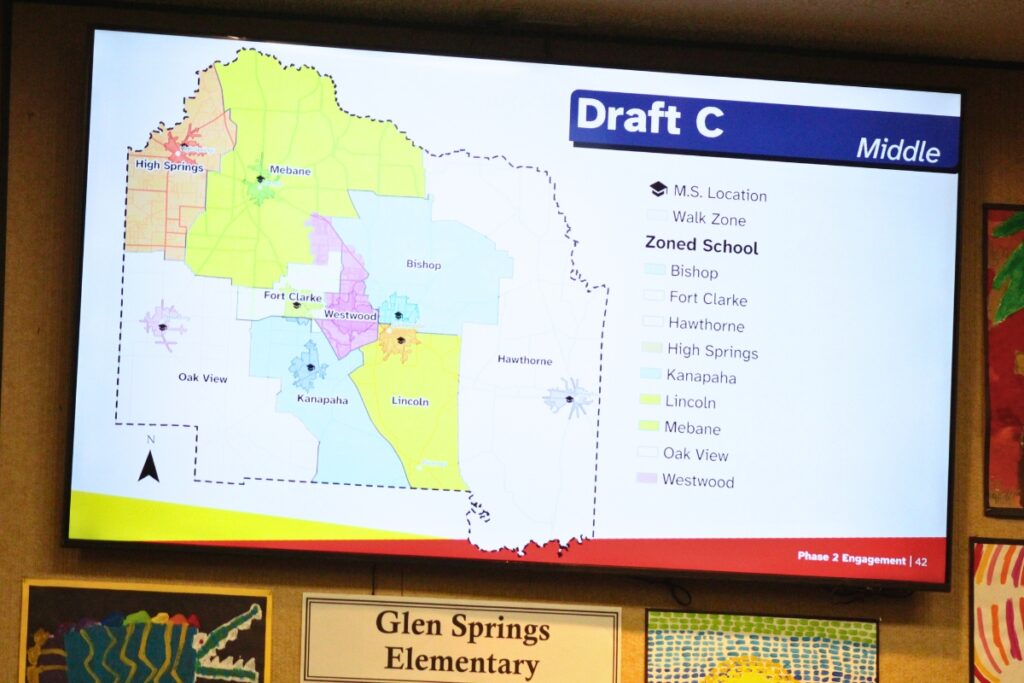
For the middle school draft scenarios, Ebaugh said all boundary line shifts and that “each scenario is slightly different than the others.”
“And because of the capacity needs at the middle school level, we looked to increase the efficiency of all middle schools,” she said. “In all scenarios, we look to draw more students to Bishop (Middle School) and Lincoln (Middle School), and we look to reduce the attendance at Kanapaha Middle School by moving the zone east.”
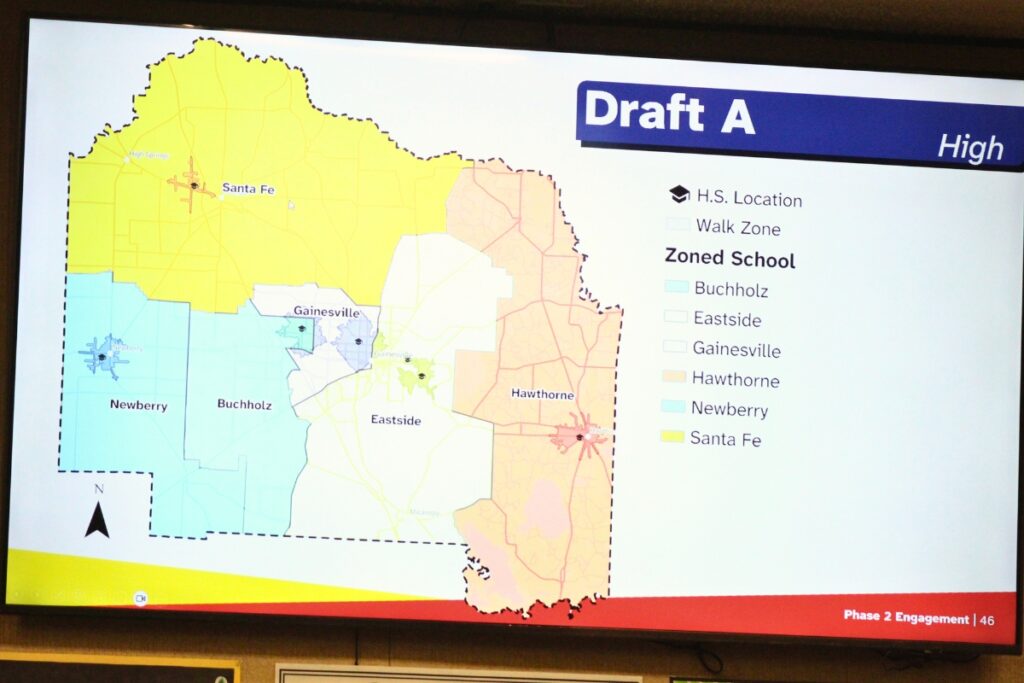
Boundary lines are also shifted in all three of the draft scenarios for high schools.
“We looked to increase the efficiency of all schools, and we looked to level out enrollment and attendance,” Ebaugh said.
In all three draft scenarios for high school, Ebaugh said Eastside High School moves west to capture more students and increase enrollment at the school. She added that there is also an adjustment to Gainesville High School’s Archer Road enclave.
Ebaugh said GHS’s zone is split into two.
“We call that an enclave,” she said. “It means that there are two separate zones for that school.”
In scenarios A and B, Ebaugh said the Gainesville enclave would go away completely by shifting the zone to the north or to the south, while scenario C would maintain a connection between the enclave.
Johnson said Thursday that no middle or high schools would close under any of the draft school boundary maps.
As is the case with the elementary school draft scenarios, Ebaugh noted that there is also a focus on transportation and walk zones for middle and high schools.
The elected officials who were in attendance for Friday’s meeting expressed a variety of concerns, ranging from walk zones and transportation to the need for more magnet programs in schools.
There were also concerns raised about the potential closures of the elementary schools listed in the draft boundary scenarios.
Ebaugh emphasized that the scenarios presented on Friday are not final.
“We are working with our communities right now to understand what adjustments we need to make, and we’ve already heard great suggestions and great ideas of where we can make a vision,” she said. “So, I can promise you that the boundary scenarios that we have today are going to be revised and adjusted based on the community input we receive.”
There are several ways for community members to engage in this project, including an interactive map, online surveys and community input sessions.
For more information about the map and surveys, visit https://jbpro-engagement.com/acps-our-schools-plan.
For a schedule of the input sessions, visit https://www.alachuaschools.net/o/acps/page/ourschoolsfutureready.
The sessions are taking place now on school campuses across Alachua County and will continue through Wednesday, Feb. 18.
Nick Anschultz is a Report for America corps member and writes about education for Mainstreet Daily News. This position is supported by local donations through the Community Catalyst for Local Journalism Fund at the Community Foundation of North Central Florida.
Suggested Articles
No related articles found.
Please leave City of Alachua zoned for Alachua schools. Turkey creek, Hague area need to remain in Alachua. Alachua doesn’t need K-8 and K-5 and split the town .