




- High Springs Police Chief Antoine Sheppard was reinstated on July 7 after an investigation cleared 6 of 11 charges related to payroll and duty discrepancies.
- Sheppard must repay any overpaid payroll and is ineligible for extra duty without city manager approval following a warning about further violations.
- The investigation began after a complaint on June 16, and a community rally showed strong support for Sheppard amid claims of procedural errors and lack of due process.
The reinstatement of High Springs Police Chief Antoine Sheppard on Tuesday concluded nearly four weeks of the city’s investigation into a complaint that resulted in the chief’s administrative leave and impending termination.
City Manager Jeremy Marshall initiated Sheppard’s leave on June 23 without detailing the allegations, which are now public after the investigation. The community quickly rallied around the chief, who’s been with the department for 25 years.
Sheppard originally faced 11 counts of various city, union and department policy violations revolving around payroll and extra duty discrepancies.
According to the July 7 letter reinstating the chief, only five of those violations—including some Sheppard acknowledged happening—had enough conclusive evidence to stand.
The infractions included offering extra duty outside department and Collective Bargaining Agreement policies, prioritizing extra duty for himself, reimbursing staff for non-eligible items within the Community Redevelopment Agency (CRA) district, and being owed pay by the city for 60 hours of extra duty.
The letter did not specify how or why the other grounds were insufficiently supported and voided.
Sheppard’s reinstatement came as a final warning that further violations could ultimately end in termination. The chief is ineligible for extra duty assignments unless authorized by Marshall and must repay the city for any overpaid payroll.
“In responding to these allegations, I do recognize that there were some issues that need to be addressed by both myself, the agency and the City of High Springs,” Sheppard wrote in an 18-page email to Marshall on Monday. “None of these issues were intentional acts to misuse the City’s funds or to violate any policy or procedure, but unintentional oversights that can be easily corrected.”
According to High Springs spokesman Kevin Mangan, a complaint from one person triggered the investigation. He said administrative leave is a commonplace protocol for complaints.
The city found out about the complaint on June 16 and gathered evidence for what it said was probable cause to place Sheppard on administrative leave and justified termination. He was made aware of the allegations three days after being placed on leave.
Consequences of the complaints depended on the outcome of a more than four-hour long predetermination hearing held in Marshall’s office on July 1, where Sheppard and his lawyer, John Whitaker of Avera & Smith, conceded or refuted the allegations presented by Marshall and City Attorney Kiersten Ballou.
Sheppard said the most concerning parts to him about the process were errors in Marshall’s letter regarding the allegations and what Sheppard called a lack of due process to participate in the investigation.
In his July 6 email, Sheppard said he hadn’t been given an opportunity to discuss and review evidence supporting the allegations, although he said an interview had initially been offered but taken away once he secured legal counsel.
He said the errors of dates in Marshall’s letter, paired with the expedited timeline, made him question the investigation’s quality.
Although Marshall said he gave Sheppard concessions because of his seniority, tensions remained high throughout the hearing.
“This is not greed, this is work ethics. And I have never taken something from the city that [wasn’t] mine. Never,” Sheppard said. “Have I done something wrong? Suspend me. Write me up. But don’t throw my name out like this and throw me in the dirt. This is fundamentally wrong.”
A large portion of the evidence came via timecards, payrolls, emails and geolocation stamps related to the incidents of extra duty from November and December 2025.
Ballou also referenced interviews conducted with officers during the investigation when asking Sheppard about how he advertised and filled extra duty shifts in the CRA.
“Would it surprise you that the officers that were interviewed indicated uniformly that there is never an issue filling the extra duty details? Matter of fact, there’s more interest than there is availability,” she said.
Sheppard said that information could’ve come from officers with agendas because he said those positions have been historically difficult to fill. He said his commitment to fill them and the way he’d done so himself had been going on since 2017.
The hearing also revealed that faulty paycheck software made it challenging to keep up with accurate shift punches and that numerous police staff, including Sheppard, often emailed the city clerk to adjust mistakes.
Sheppard said he wasn’t aware that his gross earnings for 2025 were $125,716.48, when his base salary is $108,925.70. He said he’d written checks to the city before to correct overpayments.
Another allegation came that Sheppard gave himself preferential treatment with extra duty by taking a shift at Camp Kulaqua, where his daughter was. He denied the claim and said his daughter had never had a connection to the camp.

Because the hearing was the first time Sheppard and his attorney reviewed the evidence, Marshall gave Sheppard until Monday to respond with counter evidence, which ultimately lead to the reinstatement.
Although the investigation ended, Sheppard said the repercussions left permanent scars on him and his family.
“This has been devastating. It has torn me. I don’t even want to go back at this point,” Sheppard said. “But I’ve been here working on behalf of the folks in this community.”
Unanswered questions also continue swirling throughout the community about how and why the investigation was conducted, and how the City Commission will respond.
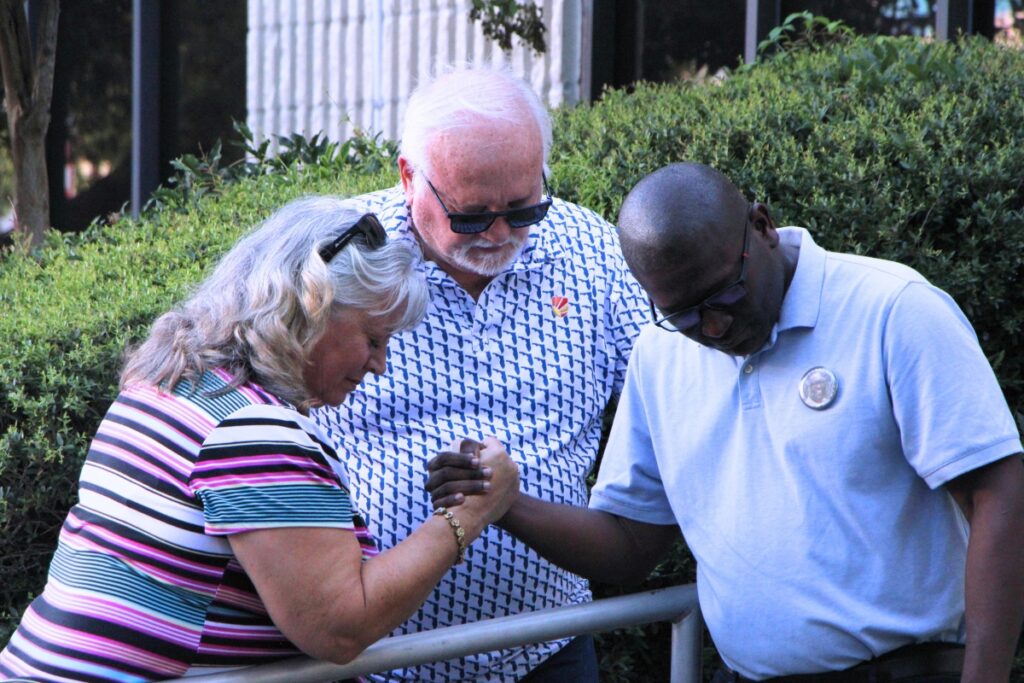
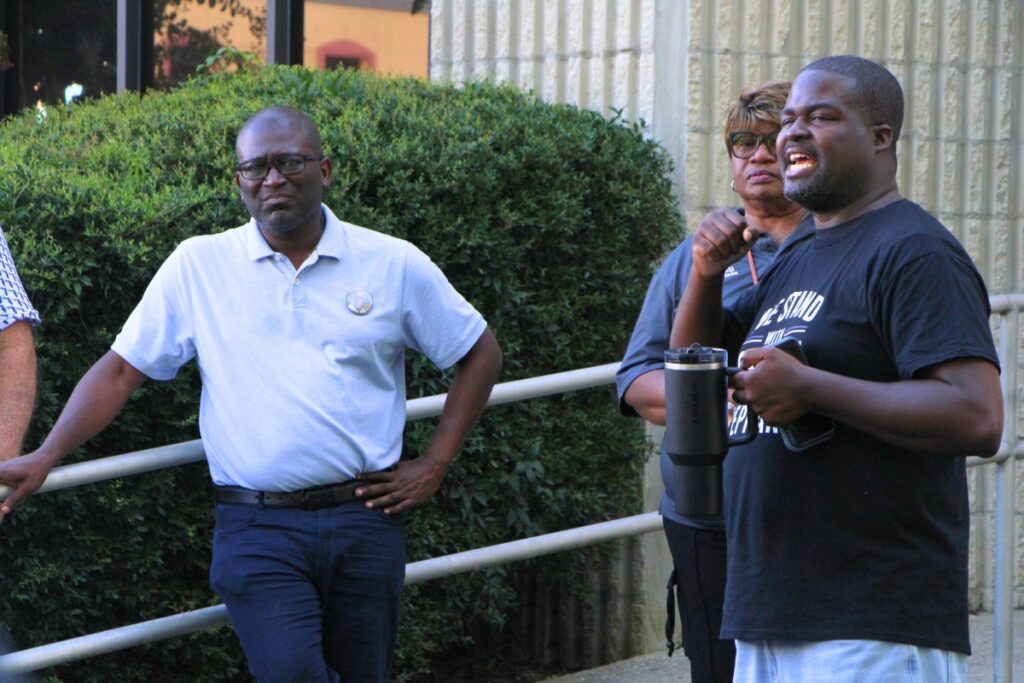
Sheppard addressed the public for the first time before Tuesday’s City Commission meeting from the City Hall parking lot during a prayer meeting organized by High Springs Police Officer Adam Joy.
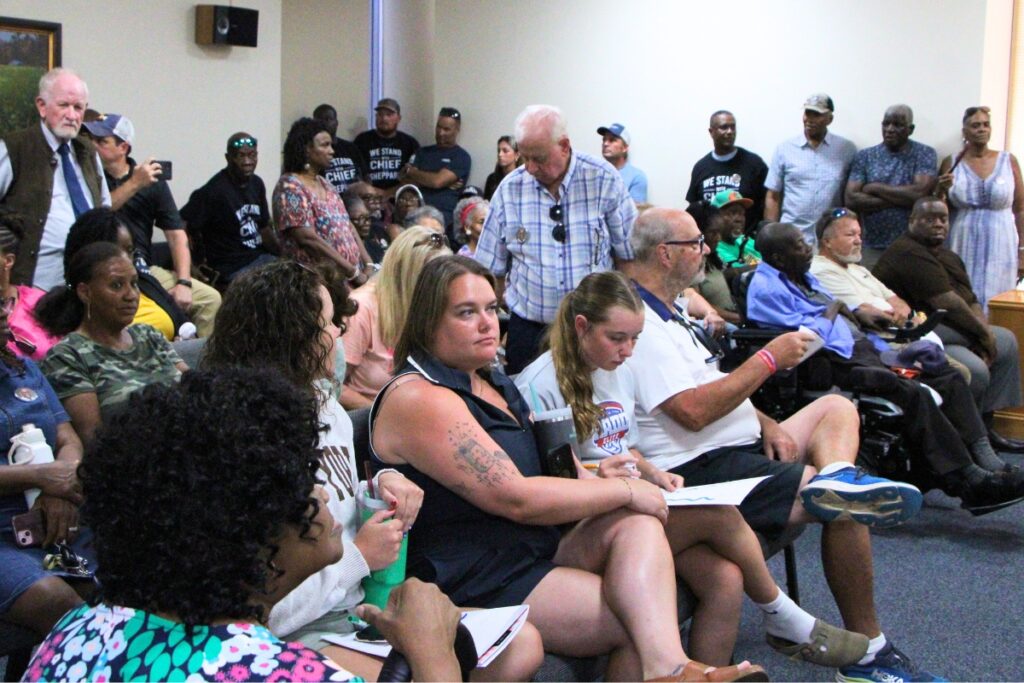
According to Joy, over 500 community members, including sitting commissioners, had expressed interest on Facebook in attending the meeting. Dozens showed up in the heat, wearing shirts that read “We Stand with Chief Sheppard.”
Near the end of the prayer meeting before the City Commission meeting, trucks from the High Springs Fire Department waded through the crowd, saying there was an emergency at City Hall, which involved a broken elevator with Commissioner Katherine Weitz trapped inside.
Residents packed City Hall to standing room only for the City Commission meeting and also watched the live stream from a downstairs TV.
But the commission voted to reschedule and relocate the meeting to July 23 at the Civic Center, which City Attorney Danielle Adams said had to be done for ADA compliance with the broken elevator.
Some, like Joy, called it a ploy to silence the public.
“I can’t say everything I want to say, but you can,” Sheppard told prayer meeting attendees. “You need to ask questions of your government.”
Suggested Articles
No related articles found.
The reinstatement of High Springs Police Chief Antoine Sheppard raises an important question: was this handled as a political matter, or should it have been turned over to FDLE from the beginning?
When allegations involve payroll and duty discrepancies by a law enforcement leader, an independent FDLE investigation would have provided greater transparency and public confidence. Instead of turning the issue into a political battle, the focus should have been on a neutral, professional review of the facts.
If the chief was ultimately reinstated, the community deserves to know that the process was independent, fair, and free from political influence. FDLE could still investigate this issue and have a different opinion.
This investigation, which encompasses numerous felony acts of malfeasance committed by Antoine was investigated by the city manager and the city attorney. I’m sure neither have much, if any law enforcement investigatory skills.
At a minimum the investigation should have been directed to and handled by FDLE in conjunction with the State Attorney’s Public Corruption Unit. Both agencies have highly qualified detectives that handle egregious acts of malfeasance, misconduct, and corruption cases perpetrated by a police chief.
Say you’re Bobi Frank without saying your Bobi Frank.
The City of High Springs may have reinstated Chief Antoine Sheppard, but that doesn’t end the story.
When a police chief faces allegations involving payroll and duty misconduct, this shouldn’t be decided by politics. Florida’s law enforcement standards exist for a reason, and an independent state review not City Hall is what builds public trust.
Police officers are held to high ethical standards. Chiefs should be held to the highest. If there are credible allegations, the appropriate state certification process should determine whether those standards were met not politicians. Reinstated by the City Doesn’t Mean Cleared by FDLE.
fact error in that story….the elevator incident happened PRE meeting not near the end as reported. If it had been near the end then the Commissioner stuck in the elevator would’ve been inside the chambers at her desk.