



- The Alachua Planning and Zoning Board postponed the Tara April permit decision to Jan. 20 for further environmental testing results.
- The Tara developments propose over 1,000 homes near Mill Creek Sink, a sinkhole connected to a karst cave system feeding the Floridan aquifer.
- Alachua County allocated $1 million for potential legal action over environmental concerns related to the Tara development projects.
- Developer Sayed Moukhtara offered to pay for recommended geophysical and geotechnical testing taking three to six months before permit approval.
Editor’s note: This story was updated with additional information.
Approval of a special exception permit for Alachua’s Tara April development stalled again as the city’s Planning and Zoning Board voted to cut Tuesday’s marathon meeting at midnight and continue at 6 p.m. on Jan. 20.
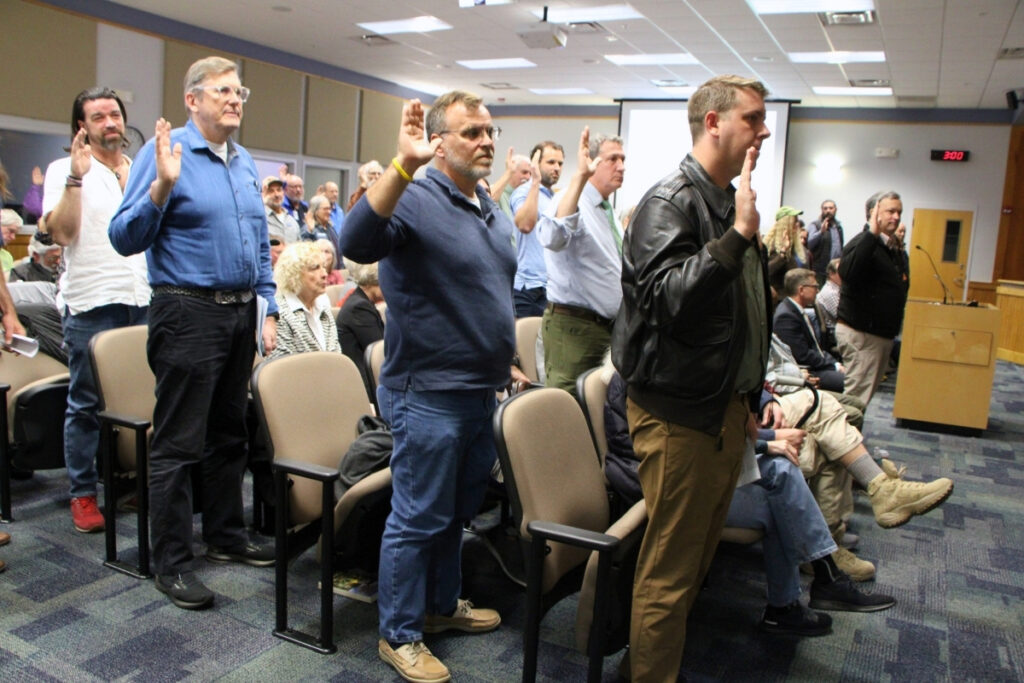
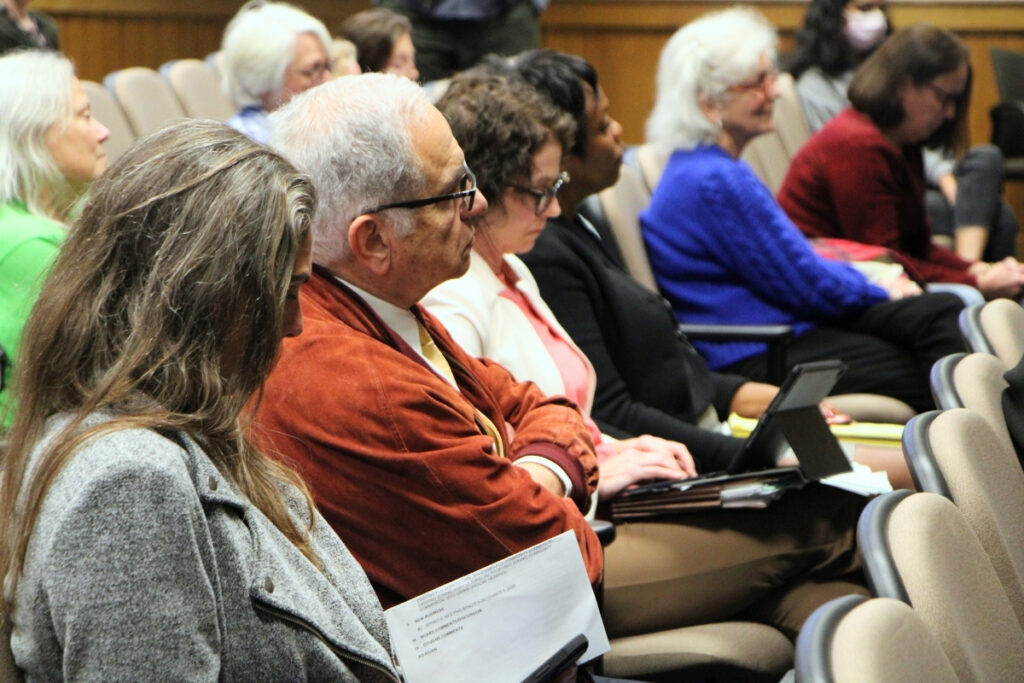
Residents, environmental professionals, government officials and divers from across Alachua County and the state packed Alachua’s commission chambers beyond capacity for the six-hour quasi-judicial hearing.
Tara April is one of five Tara projects planned by developer Sayed Moukhtara, who also attempted to develop near West End Golf Course.
The Tara developments would bring over 1,000 homes and commercial components near Mill Creek Sink, a sinkhole which connects to an underground karst cave system and feeds into the Floridan aquifer and wells.
According to the Alachua County Environmental Protection Department, the area has the highest concentration of freshwater springs in the world and brings in millions of dollars from recreation.
Tara April is slated for 58 acres, with six and a quarter set aside for stormwater infrastructure needed to support Alachua’s Tara developments. The infrastructure calls for two dry, shallow retention basins that are considered minor utilities in the special exception permit and a third, larger basin for I-75 runoff in the infrastructure plan.
Clay Sweger is the director of planning for EDA Consultants and made the special exception permit request on behalf of Tara April’s applicant.
He said the permit is needed because stormwater retention is being proposed for agriculturally zoned land to support future commercial development. Without commercial development, Sweger said there is no use for the stormwater retention.
Alachua County Growth Management Director Jeffrey Hayes added that the quality of stormwater coming from commercially developed land may be reduced, necessitating the permit.
Many staff who were with the city when Tara applications started coming to Alachua have since resigned or been fired, including 75% of planning staff, the city manager, the city attorney and the land use attorney. One former planner cited outside influence from a former city manager on the Tara projects as part of his decision to resign.
Patrice Boyes of Holtzman Vogel served as the city’s land use attorney during Tuesday’s hearing. Boyes worked from August 2024 to March 2025 with Florida-based firm Stearns Weaver Miller, whose attorneys Vinette Godelia and Susan Stephens represented Moukhtara at the hearing.
The Planning and Zoning Board entertained presentations and testimonies from representatives for the city, the applicant and parties that could be impacted by the proposed development as evidence for or against the permit.
Affected parties included the National Speleological Society, which is a cave and karst research non-profit that owns Mill Creek Sink land, Santa Fe Hills resident Soorya Lindberg, the city of High Springs and Alachua County, which set aside $1 million for potential legal action due to concerns over Tara’s environmental impacts.
Parties also read a November email into the record from the Florida Department of Transportation to the county, saying it did not need the stormwater infrastructure as Tara April proposed.
“The department prefers that the stormwater from the I-75 basin continue to free flow in the way that it does today without any restrictions,” the email read. “The Department is in no need of water quality treatment since the I-75 basin has its own stormwater treatment system that was permitted by SRWMD (Suwannee River Water Management District). Additionally, the proposed plan will be cutting off the base flow to the wetlands to the east.”
City planning staff recommended approving the Tara April special exception permit, which carried 11 new conditions that the applicant would need to incorporate.
The conditions included over a mile of recreational trails, eliminating commercial components, like tire sales and carpet cleaning, that could produce hazardous waste and geological testing following application approval. The applicant would pay for the testing, which would take three to six months.
However, all four board members said they weren’t comfortable voting without results from geophysical and geotechnical testing of the entire Tara development area—not just Tara April—as recommended by Apex Companies hydrologist Michael Alfieri, whom the city hired as an outside consultant for the project.
The applicant offered to hire its own consultant to perform the recommended testing before the board made a decision. But board member Danielle Judd said she still didn’t want to vote without the infrastructure plans for the basins because she’d be approving a use without knowing what the end answer is.
“I can’t vote to move forward with the special exception without having the complete picture,” Judd said. “So for me, if I had to do a motion tonight, it would be deny, and that would be the end of it.”
The board agreed to extend the meeting past its usual 11 p.m. cutoff but stopped at midnight to avoid adjudicating without an official court reporter.
The Tara April hearing will continue Jan. 20, first with public comment, then rebuttals from affected parties and concluding statements, before the Planning and Zoning Board votes on how to proceed with the permit.
If denied, the applicant could abandon the project altogether or take legal action against the city. If approved, the applicant would submit infrastructure plans for the stormwater basins, which the Alachua City Commission would review for approval.
The inconclusive meeting is the permit’s third delay after staff pulled the item from an agenda in September 2024 without a future meeting date, and the Planning and Zoning Board granted a continuance in November 2025.
The permit
In 2021, the City of Alachua amended its comprehensive plan to add requirements for treating stormwater runoff from I-75 free flowing into Mill Creek Sink. Sweger said the Florida Department of Environmental Protection and the Florida Department of Transportation reviewed the amendment.
He also said Tara April went through nearly 20 hearings with approvals in the past 15 years and received an environmental resource permit from the SWRMD, whose review found no impacts to wetlands or surface waters.
Sweger and city staff said the project’s application met the amendment’s eight standards: compliance with specific use regulations, compatibility, design minimizes adverse and environmental impacts, roads and other public facilities, doesn’t injure neighboring land or property values, has drawings and complies with all other relevant laws and ordinances.
On Tuesday, staff presented 11 more conditions the applicant would have to meet if the Planning and Zoning Board approved the permit. The conditions are:
- An interpretive kiosk explaining the merits of the Mill Creek Sink Stormwater Enhancement Park.
- Reducing commercial uses that could produce hazardous waste, such as carpet cleaning, parking lots, tire and gasoline sales.
- At least two points of access to the stormwater trails for the neighboring commercial development.
- A network of sidewalks.
- Construction of the roughly one-mile, privately owned and maintained trail system that will be influenced by the geological study results.
- Temporary parking until permanent parking comes with future commercial development.
- Local, state and federal permits.
- The development order authorizing the permit must be recorded into Alachua County records at the cost of the applicant.
- The development order for the special exception will not take effect until the geological testing outlined by Apex Companies is completed.
- Stormwater management facilities will be altered before development if necessitated by the geologic test results.
- The applicant agrees that the list of conditions is best and will comply.
Counsel for the applicant said six more conditions are being considered, but they did not say what those were.
They emphasized that the board’s approval of the special permit didn’t approve construction of the basins. But some of the members questioned how they could approve Tara April without considering its impact on the other Taras planned for the area, which it would be built to serve.
Planning Department Director Bryan Thomas said that while there is substantial interconnectivity between infrastructure plans for the Tara developments, the special permit application doesn’t immediately initiate construction.
Newly appointed board member Bill Menadier said Tara April held floodplain compensation for the Tara Phoenicia Development, proving, along with the geological study, the pertinence of interrelated information between the developments.
“What I’m trying to wrap my head around is whether or not the board is being asked to rely on a future review to satisfy today’s special exception findings,” Menadier said.
Putting geological concerns about the Tara property aside, Judd said she had trouble approving the special permit when infrastructure plans could include aspects the board wouldn’t approve, such as oversized basins, when the plans wouldn’t come back in front of the board before going to the City Commission.
Senate Bill 784 took effect on July 1 and grants the city’s Land Development Regulations Administrator, interim City Manager Rodolfo Valladares, the final say for approving land developments instead of requiring a vote from the commission dais.
The City Commission would review results from the additional geological testing and vote accordingly.
“Special exception, in my mind, is simply a use question, right?” she said. “But somehow we’ve got ahead of ourselves with all these other things in my estimation. And so that causes me to ask some additional questions.”
Additional geological testing
Alfieri is a nationally certified hydrologist with Apex Companies and a professional geologist licensed in 13 states, including Florida. The city hired him to provide recommendations for testing the site, which he presented to the board.
He said karst is a land feature created by the dissolution of carbonate rock, which forms the Florida Platform.
He presented various topographical maps of the Mill Creek Sink and Tara April areas, noting potential depressions that can lead to fractures and sinkholes. The only way to determine if the depressions are real, he said, is through testing.
Alfieri said Apex recommends comprehensive geophysical and geologic testing on the entire proposed Tara development property, not just Tara April. The process would involve a site visit by Alfieri, while other crews selected by Moukhtara conduct the testing.
“The recommended additional work will address geologic uncertainties and produce necessary information in the interest of public health and safety, the environmental integrity,” Alfieri said.
Alachua County as an affected party
Three out of five Alachua County Board of County Commissioners attended Tuesday’s hearing, where the county testified as an affected party.
Mary Szoka, a water resources engineer for Alachua County’s Environmental Protection Department, said she helped work on Alachua’s initial Mill Creek Sink water quality improvement project.
She said studies for the project showed it needed to shift north to mitigate potential sinkhole formation. Even with the precautions, Szoka said a chimney sinkhole presented in 2021 and there are active sinkholes on the Tara Forest West property.
Szoka also said that while some supporters of Tara April’s permit say it will not impact surface water and wetlands, it will impact groundwater.
She said a dye trace study aimed at tracking water flow from Mill Creek Sink was conducted in 2005. Dye dropped in the sink took 12 days before it was detected in Hornsby Spring in High Springs and the well for the Santa Fe Hills neighborhood.
Szoka said other areas of the Santa Fe springshed can take thousands of years to travel.
Alachua County Environmental Protection Director Stephen Hofstetter said the county and the applicant both agreed that additional geological studies should be conducted before construction. The difference, he said, is whether the test should happen before or after the permit is approved.
Like Judd, Hayes said he wasn’t comfortable with plans not coming back before the Planning and Zoning Board.
“It is this board who has been charged with approving and denying these applications based on the data presented,” Hayes said. “It’s not appropriate in the eyes of the county for that to be pushed off to an administrative decision by staff.”
Attorney for Alachua County, Sylvia Torres, established during cross-examination that without the extra geological testing, no one can know whether the site is stable enough for the proposed construction.
She also said she recalled plans from 2015 when a developer intended to build a Walmart in the same area as the Tara developments. The county brought a comprehensive plan challenge against it.
High Springs and Camp Kulaqua as affected parties
High Springs’ Parks and Recreation Director Jennifer Applebee served as the acting city manager on behalf of High Springs for the hearing.
She said her city has a “sincere vested interest” in the board’s decisions as the proposed stormwater basin location could cause significant detriment to the quality of High Springs’ drinking water.
“We in the city of High Springs are committed to preserving the quality of our water, our rivers, our wetlands and the Floridan aquifer,” said Applebee.
Phil Younts is the executive director for Camp Kulaqua Retreat and Conference Center in High Springs, which surrounds Hornsby Spring on more than 800 acres.
He said the camp has enjoyed the spring there since the camp started in 1953 and is concerned about changes to the water quality, especially with more than 50,000 people attending the camp every year.
The National Speleological Society as an affected party
Tampa-based lawyer Jane Graham represented the National Speleological Society (NSS) as an affected party.
The NSS’s case included testimony from hydrologist Stephen Boyes and Florida A&M biology professor Thomas Sawicki, each speaking to geological and biological threats posed to the sink area with Tara and advocating for further testing.
Stephen said Alachua County sits above a fracture zone that stretches almost its entire width. He said this, along with changing land use and drainage patterns, makes the area of the proposed development high risk for subsidence and sinkhole development.
“Collapse in this area could create life-threatening conditions in and around I-75, as well as for any divers that might be diving in the cave system at any particular point in time,” he said.
Graham objected to claims that the application met all the necessary conditions and said the six new undisclosed conditions didn’t give affected parties a chance to respond.
“There are lives and property at risk, and it should not be gambled with,” she said.
Soorya Lindberg as an affected party
If Mill Creek Sink is impacted, Santa Fe Hills resident Soorya Lindberg said her water is, too.
Lindberg identified as an affected party because she said dye from the dye trace study of the sink showed up in her water.
She presented excerpts of documents from planning and city staff, including a letter from former land use attorney David Theriaque, who wrote in 2022 that Tara April is “inextricably intertwined” with the proposed neighboring Tara developments.
Lindberg asked if a third party would be allowed to do independent testing of the development site in addition to the contractor hired by Moukhtara.
After initially accusing Lindberg of not trusting the city or the applicant and the contractors they hire, Godelia said the applicant would allow a third party if the Planning and Zoning Board and City Commission wished.
When Lindberg asked for proof of material verifying that Tara April’s permit meets the condition that it minimizes environmental impact, Thomas said the opinion was based on information provided by the applicant.
She also asked Sweger if infrastructure plans for Tara April had already been submitted to the city for review, and Sweger said yes. But Lindberg said when she made a public records request in November 2025 for the Tara April infrastructure plan, she was told there were no conclusive records.
“I did not get anything. That is a concern,” she said.
Editor’s note: This story was underwritten by a grant from the Rural Reporting Initiative at the Community Foundation of North Central Florida. To learn more or get involved, click here.
Suggested Articles
No related articles found.
Note the water shortage advisory story today for additional context. This isn’t just an isolated property rights issue.
Y’know, we really do NOT need this “Tara” thing. It would be just another step in turning North Central Florida into an Orlando-style environment.
“Tara”-bull.
Duh.